
Are you sure you know your local high season?
Portorož and Piran are known as summer destinations. Yet in December 2024 and December 2025, the Piran area, including Portorož, recorded more guest nights from Slovenian residents than any other destination in the country. In December 2025, that meant around 29 thousand guest nights from domestic visitors alone. Summer remains its busiest season overall, while December reveals the strength of its domestic market. (1, 2, 3, 4)
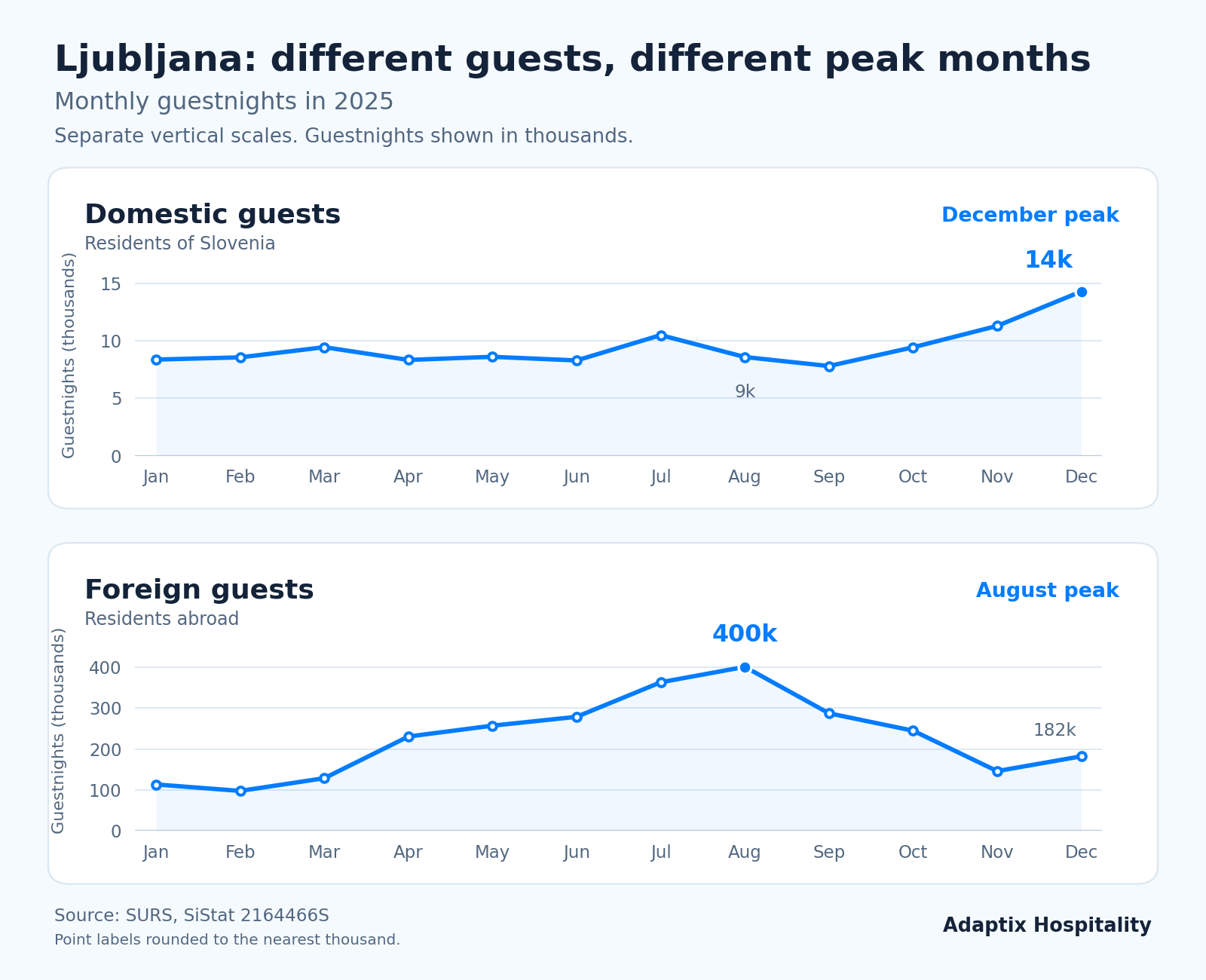
Ljubljana shows why it helps to look at different groups of guests. In our comparison of SURS monthly figures for both years, foreign guest nights peaked in August, while domestic guest nights peaked in December. In 2025, domestic visitors generated roughly two-thirds more nights in December than in August. (4)
Your destination’s overall peak can hide a different pattern among the guests you want to attract.
What this means for a host
Suppose you usually promote your Ljubljana property to international visitors in summer. These figures give you a reason to investigate a December offer for guests from Slovenia. Check whether your accommodation fits that audience, make the offer clear in Slovene and compare prices for similar stays on the same dates.
To explore the idea, compare at least two complete years of monthly figures. Look at domestic and foreign visitors separately, then at individual countries that matter to your property. Check whether the peaks repeat, and compare the pattern with your own bookings: who comes, how long they stay and which dates remain empty.
What SURS measures
SURS is the Statistical Office of the Republic of Slovenia. It publishes official tourism statistics, including tourist arrivals and overnight stays. (5)
Registered accommodation providers report guest stays through AJPES’s eTurizem system, one of the administrative sources behind these statistics. The figures cover hotels, campsites, apartments and other registered accommodation. (6)
Arrivals count guest check-ins. Overnight stays count nights by person: a family of four staying three nights contributes 12 guest nights, while the apartment is booked for three nights. This distinction matters when comparing tourist activity with your own booking calendar. (6)
Where to find the figures
The data are publicly available free in the SiStat database. In the monthly table used for this article, you can select a place, months and the guests’ country of residence, then choose arrivals or overnight stays. You can view the results online or export them for your own comparison. (4, 7, 8)
Explore the monthly SURS table
Check the geographic coverage of your selection. A familiar place name can represent a wider area: the Piran figures, for example, include Portorož and the surrounding area. (4)
How Adaptix collects and updates the data
SiStat provides an API, an interface that allows software to retrieve data automatically. (7)
At Adaptix Hospitality, we retrieve the SURS figures we use programmatically, through an automated process that runs every day. It checks for new publications and adds new figures when they become available.
Our daily retrieval works with a monthly statistical series. SURS publishes this series after each reporting month. Between releases, the latest available month stays the same. (6)
How this connects to your nightly price
SURS helps you understand recorded tourism activity. For our local market reviews, we combine these figures with AJPES data on registered accommodation supply and AirROI’s historical estimates of rental rates and occupancy.
Use the review to choose which months and guest groups to examine. Then compare the nightly price you need to cover your costs and desired earnings with similar stays on Booking.com, Airbnb or the platforms where you list. Match dates, length of stay and total guest price, including extra fees.
Each review identifies its sources, geographic coverage and data periods. A saved review retains the data snapshot used when it was created.
We’re offering our first local market reviews free in exchange for your feedback.